Having been made into the tourist trap that it is, the city of Aguas Calientes is stuffed full of restaurants. But they all have one thing in common – they are geared for tourists and offer food at tourist prices.
But a smart traveler realizes that all those locals who stick around Aguas Calientes in order to take advantage of the tourists lured by the overblown promotion of Machu Picchu also need to eat, and they surely don’t dine in any of the tourist restaurants.
Here’s where the Central market of Aguas Calientes, otherwise known as Mercado de Abastos (Food Market) comes to play.
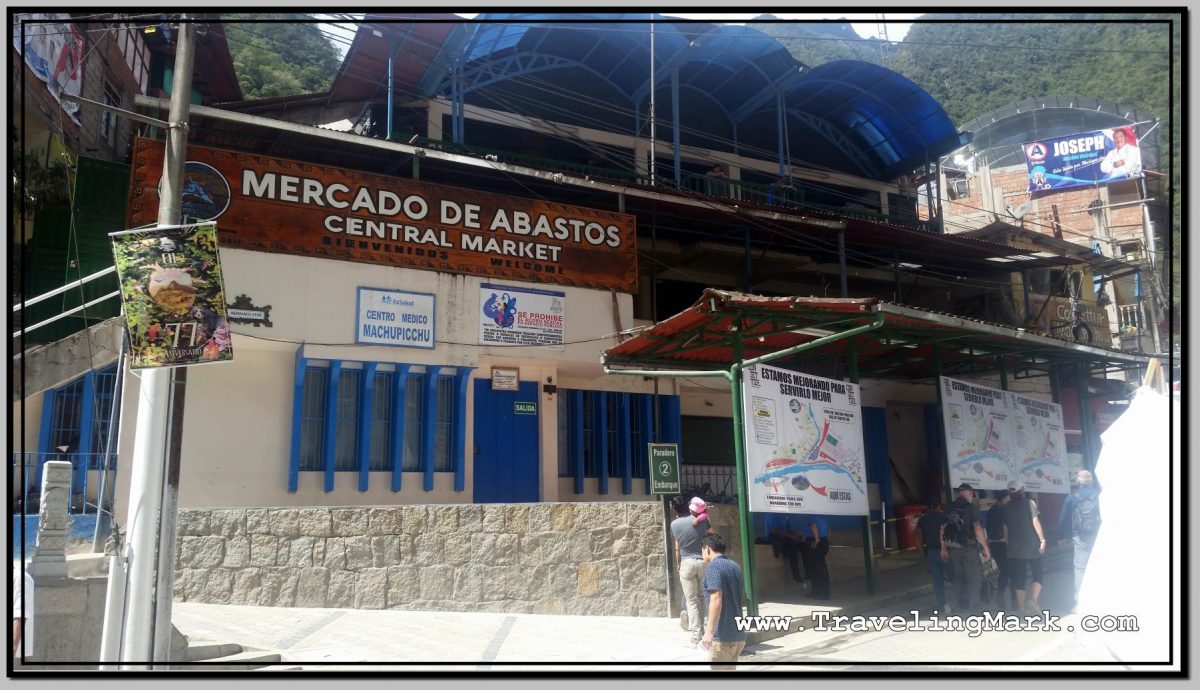
Photo: Building Housing Mercado de Abastos in Aguas Calientes
Located close to the train station in the Machu Picchu Pueblo (the name into which the Peruvian government is trying to rebrand Aguas Calientes), Mercado de Abastos towers rather inconspicuously a little bit up the stairs, in a building that hardly attracts any tourists, despite thousands passing in front of it literally on a daily basis.
On the main floor of Mercado de Abastos one can encounter sellers of fresh fruits, however just as everything in Aguas Calientes, these are all heavily overpriced, having been shipped to the pueblo by train. Once done asking fruit sellers for prices but not buying anything because of the ridiculous price, an unlikely tourist can walk up the stairs to reach the market’s upper floor, and encounter stalls selling cooked dishes for the locals who work in the many of Aguas Calientes’ tourist establishments.
Even though at 12 Soles for a menu consisting of a soup and a main dish, the prices up there are still high by Peruvian standards, Mercado de Abastos is the cheapest place to get fed in Aguas Calientes, and truly the only somewhat economical way to eat while waiting to go up to Machu Picchu.
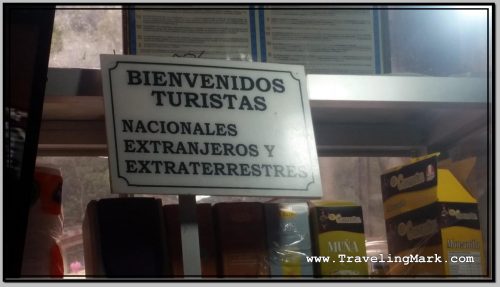
Photo: Sign in Food Stall Where I Ate Saying “Welcome Tourists, Locals, Foreigners, Extraterrestrials”
I definitely took advantage of it, and even though during my 3 day stay in Aguas Calientes I was the only tourist who took said advantage, it didn’t bother me one bit being surrounded by locals slurping loudly their food and chewing it with their mouth open like a pack of cows on a field, because it came with the good feeling that I wasn’t allowing the overpriced services of Aguas Calientes take advantage of my being there entirely.
Upon descending the Pinkuylluna Mountain, I met a middle-aged American couple who asked me if where I came out of was the entrance to the hill with the ruins. I ended up having an interesting conversation with them right there on the narrow, cobblestone covered street of the old Inca part of Ollantaytambo.
At one point they mentioned they had dined at Apu Veronica Restaurant located across the bridge heading out of town, and recommended the restaurant to me for some of the best food in town. So I made a point of heading out there and satiating my digestive system after the uphill climb.
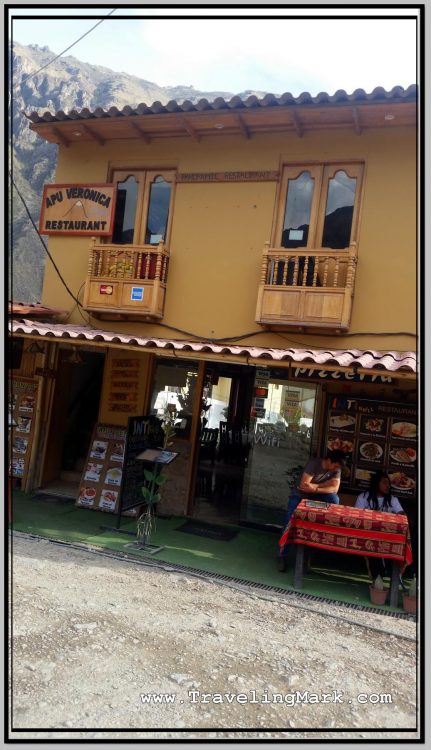
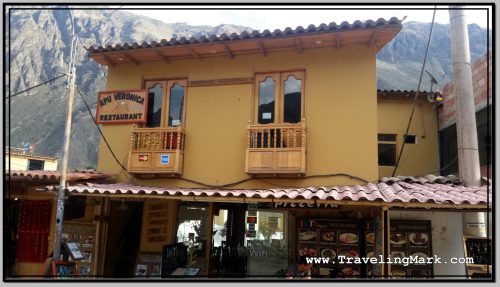
Apu Veronica is, exactly as the Americans told me, across the bridge heading toward the fortress. It is located on the second floor of a building, but is well marked to make it easy to find.
Photo: Apu Veronica Restaurant Is Located on the Second Floor
I walked up and seated myself in the smallish restaurant currently catering to just a couple of people eating there. However despite being noticed by the staff, I was totally ignored for the longest time.
I proceeded to walk up to the counter and grabbed a menu out of there myself, thinking this would get the message across and a waiter would come to ask what I wished to order. That never happened.
The menu suggested heavily overpriced dishes, but whereas one of the dining patrons was a local, I knew they also had locally priced options. I found those on an individual sheet on the counter.
Photo: Apu Veronica Restaurant in Ollantaytambo, Peru
Called “Daily Menu“, this option offered a selection of a few pre-made dishes for 15 Soles which included a small plate of soup and a glass of Chicha Morada (traditional Peruvian non-alcoholic, sugar sweetened beverage of deep purple color made from dried dark corn). Compared to the dishes listed in the menu, which sell for upward of 70 Soles (over $21 US) per plate, these three course meals are hell of a better deal, but as a foreigner, you’re not supposed to know about them. That’s if anyone bothers to serve you in the first place.
Having figured out what I wanted, and having demonstrated to the staff that I’m indeed present in the restaurant and ready to place an order, I expected a waiter to finally show up after some 15 minutes of ignoring me in the restaurant with hardly any people to keep them busy. It never happened, so I stood myself up, walked up to the counter again, and called up a waiter to place an order there.
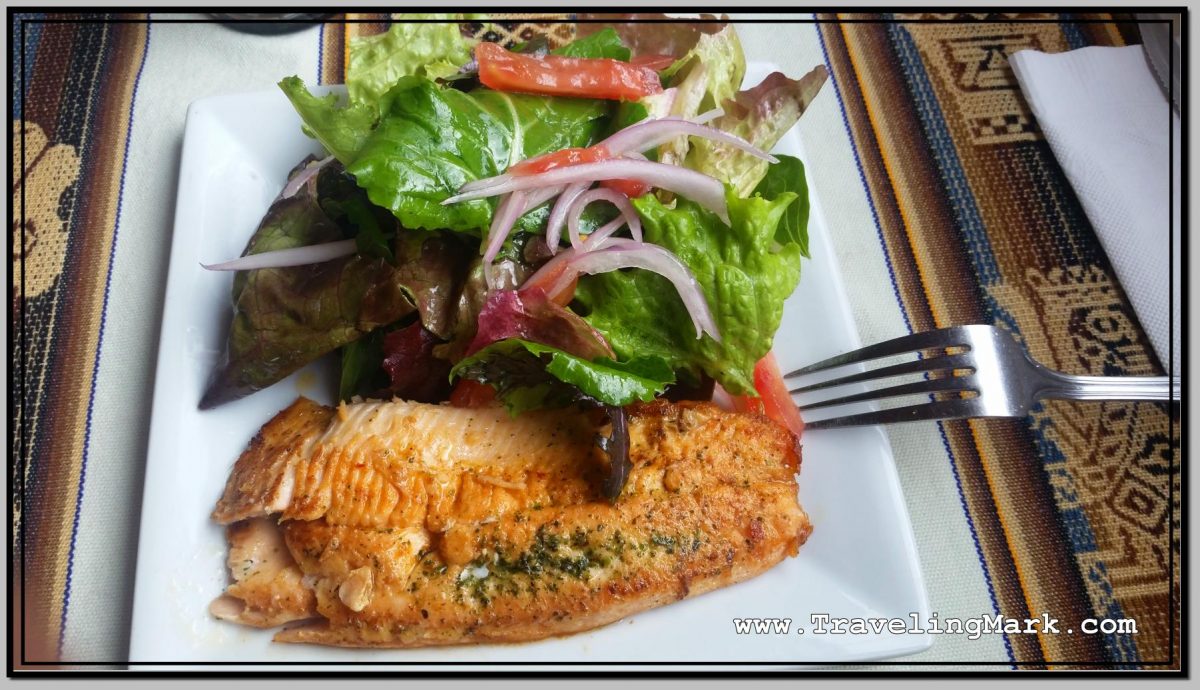
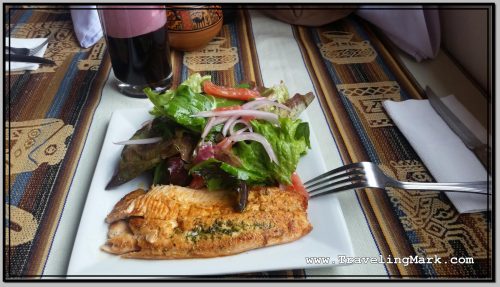
I ordered fried trout, but asked if instead of standard rice as an accompaniment, I could get a portion of fresh salad made from whatever veggies they had in the kitchen. The waiter said it shouldn’t be a problem, so I went to sit myself down at my table again.
Photo: Fried Trout with Fresh Salad and Chicha Morada at Apu Veronica Restaurant
As per the speed of previously demonstrated service, it took forever to finally bring me my order, but nevertheless, I got the trout exactly as I asked for. Compared to what I got in nearby Puno for half the price, this was a miserable portion of fish, but I was in the Sacred Valley of the Incas, so I took it as it was.
I went to Apu Vernica after descending the Pinkuylluna Mountain so I did feel like unwinding after the heart pumping uphill trek, which is probably the only reason why I stuck around. The terrible service with no reason to justify the insanely long waiting times was otherwise inexcusable. The food however, I have to admit, was tasty and the cook prepared it for me the way I wanted, so I feel like my review is at the draw as far as recommending or not recommending the restaurant.
Photo: Other Dining Options in Ollantaytambo Sometimes Put a Smile on My Face
Furthermore, unless you get sucked into ordering one of the hard core overpriced options from the foreigners’ menu, the value for money in Apu Veronica is decent. The food was safe and didn’t make me ill, so I’ll leave it at just that – Apu Veronica is probably a decent choice for dining in Ollantaytambo, but not if you don’t have whole day to wait for service, or are really hungry.
While still in Cusco, I told Maria whom I was going to meet in Lima, that even though at the time I’ve already been in Peru for 3 weeks, yet have still not eaten a Peruvian ceviche. Since we maintained contact the whole time on the internet and finally set up a date to meet up in real life, I thought it would be the perfect time to finally try ceviche.
Under normal circumstances, I take the masculine role in a relationship, but whereas I’m not familiar with Lima and she is from there, I gave the responsibility for picking up a suitable restaurant for my first time pure Peruvian ceviche to her.
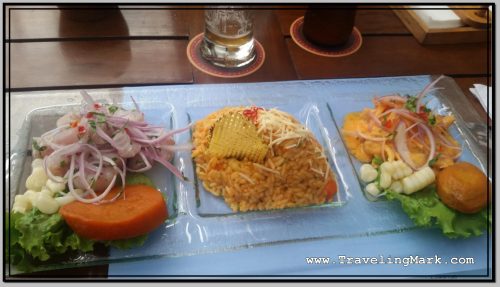
She picked a restaurant called El Chef y El Mar, and it did not disappoint. Located in San Miguel where I was staying, the more upscale restaurant had the prices to match the quality and the atmosphere, but that only made the place more perfect for the occasion.
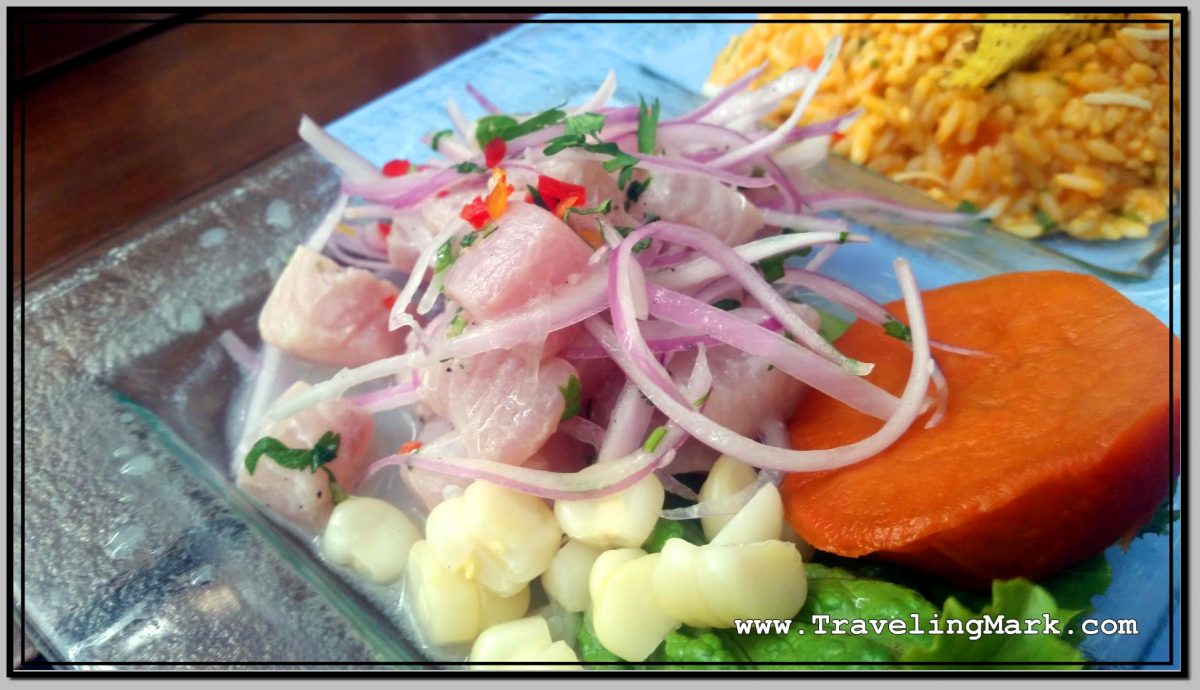
Photo: Triple Ceviche Platter from El Chef y El Mar Restaurant in Lima, Peru
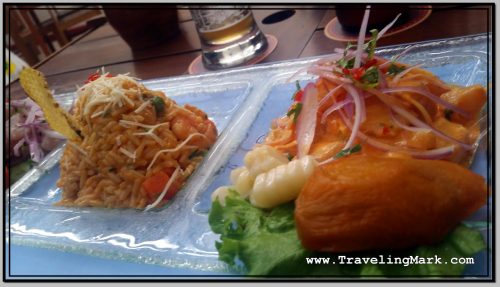
At El Chef y El Mar, there were several dished with ceviche on offer. We picked a platted for each consisting of two different forms of ceviche and a creamy rice with the calamari. I asked for my ceviche to be extra spicy, Maria went for medium spicy. It was delicious to the last bite. I could not have asked for a better place, company, and type of food to start my addiction to ceviche.
Ceviche Origins
Ceviche is considered one of the flagship dishes of Peruvian cuisine, being one of the most traditional meals offered in Peru.
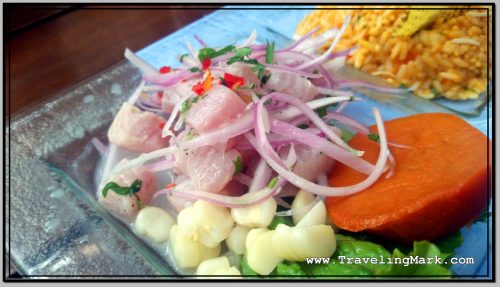
Photo: Peruvian Ceviche Made from Corvina – Chilean Sea Bass
According to the Peruvian historian Javier Pulgar Vidal the name ceviche comes from the Quechua word “siwichi“, which means “fresh fish” or “tender fish“. One hypothesis proposes that the words Siwichi and Sikbaǧ were confused during the conquest of the Inca Empire by the Spaniards, which caused that it was transformed into the name with which we know it today.
Peruvians claim that ceviche originated in the Mochica Culture on the Peruvian coast, more than two thousand years ago. However Ecuadorians maintain the pre-Inca Empire people along the Ecuadorian coast used to prepare the same cold fish dish for just as long, claiming the origins of ceviche were not exclusively Peruvian.
Photo: Creamy Rice with Shrimp and Spicy Ceviche Were Part of the Dish
In both cases, ceviche was originally being prepared by marinating the catch from the sea with chicha – juice that comes from corn.
Later, with the Hispanic presence, two ingredients of Mediterranean cuisine were added: lemon and onion. The development of the lemon farms in the lands helped to shorten the time of preparation of this ancestral dish.
Ceviche Description
Put bluntly, ceviche is basically raw fish marinated in soury, vinegar like solution. If you like raw fish in sushi, you will likely love ceviche.
From my standpoint – having come to Peru from Slovakia, where what is known in Peru as Ceviche is commonly available in its Slovakian form as “Zavinace” and purchasable from pretty much any grocery store for under a Euro, I was already familiar with the type of fish and had taste buds tuned in to it.
Ceviche in general is not the cheapest dish to eat, but a trip to Peru would simply not be complete without giving it a try in some proper restaurant where it is properly prepared.
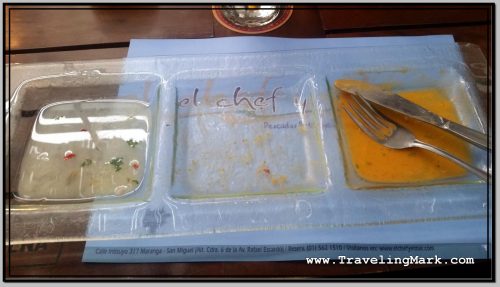
Photo: I Cleared by My First Plate of Ceviche in Peru
Caution eating ceviche is however well warranted, as improperly prepared ceviche can be the bearer of bacteria that could seriously harm your health and screw your entire trip.
Fish used to prepare ceviche should be fresh out of the sea and should be eaten early in the day. As a way to honor this requirement, many ceviche restaurants close in the afternoon.
Concluding the First Date with Maria
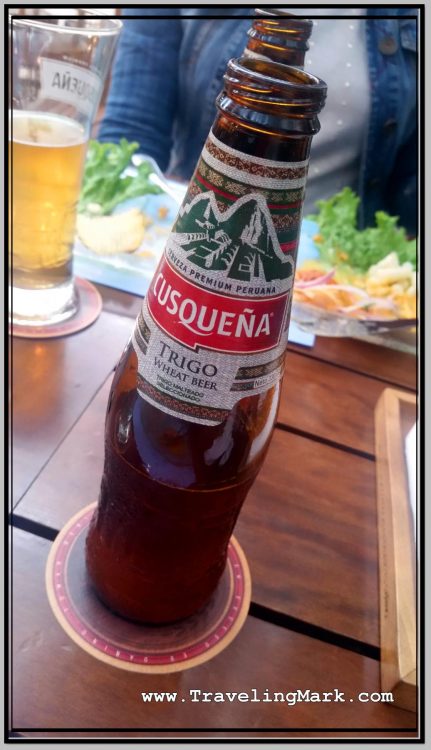
After enjoying the wonderful triple dish of Peruvian ceviche for the first time, with our bellies happy, I took Maria to a billiard club where she played pool for the first time in her life, and then to a bar where we downed a few Cusquena beers. Late at night, we parted our ways after what for both of us was a highly fun and fulfilling date. We had one more day to spend together afterward, and we both looked forward to it.
Photo: Bottle of Cusqueña – Peruvian Beer Out of Cusco
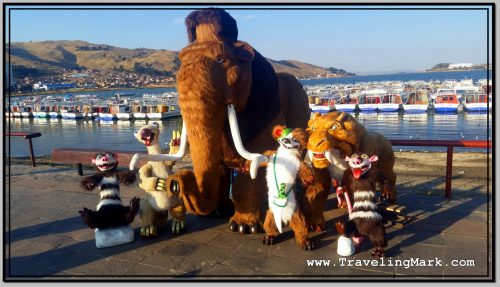
The Port of Puno, located on the Lake Titicaca, is a safe and clean area full of shops selling handicrafts, and restaurants serving fish from the lake.
Photo: Ice Age Characters at Port in Puno, Peru
I popped into one to try local trout. I enjoyed fresh and pollution free trout in Papallacta, Ecuador, where it cost $6 US, so I wanted to compare how Peruvian trout compared to the Ecuadorian in both quality and price.
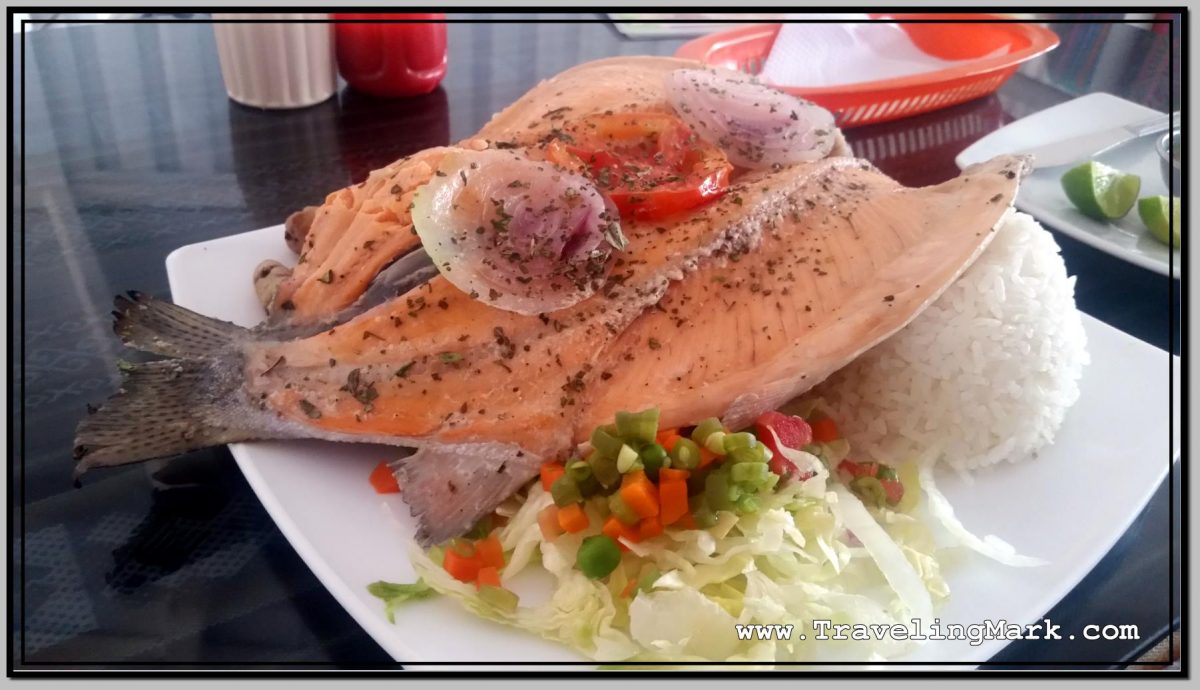
What I liked the most about the restaurants at Puno Port, was that aside from common trucha frita (fried trout), they also offered trucha al vapor (steamed trout). With the nutrients preserved better in steaming as opposed to deep frying, the trout “al vapor” is much healthier and tastier. Certainly a point for Peru.
Photo: Steamed Trout Dish at Port in Puno on Lake Titicaca
I also liked that at Puno Port, I could choose from a vast array of accompaniments, including french fries, baked potatoes, steamed root vegetables, veggie salad, cooked corn, etc. In Ecuador’s Papallacta, trout came with accompaniments too, but they were always set to fries and a bit of salad, with no option to chose what I’d like. However, in Ecuador, unlike in Peru, the trout also came with a bit of a soup and a beverage. This part was a draw.
The Puno trout was beyond compare larger than what you get in Papallacta, and the overall portion of food on the plate was larger too. I’m a big guy and this was my first meal of the day after walking around the city for a few hours, but I could not actually eat all of what I had in front of me (I left steamed potatoes on the plate). This was definitely a point for Peru, as portions in Ecuador were much smaller.
Waters of Late Titicaca are however murky and full of waste from virtually every house in Puno and all other communities on its shores. Many parts around the lake stink like sewage, so trout from Titicaca is certainly filthier than that of Papallacta, where water is crystal clear with nothing around to severely pollute it. A strong point for Ecuador.
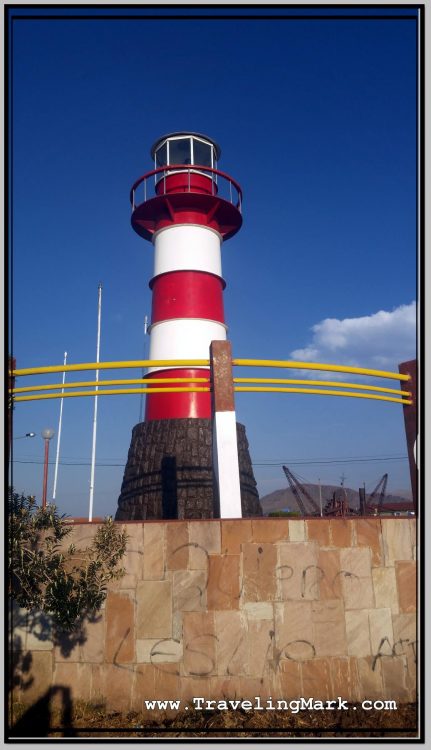
Photo: Puno Port Lighthouse
Lastly, the price for the plate of trout in Puno was 16 Soles, which was about $4.84 US at the time of my visit, making the dish in Peru a slightly better deal than in Ecuador. Needless to say, whereas that option existed, when I returned to have trout in the same restaurant again the following day, that time around I only ordered half the fish, which came at half the cost of 8 Soles (about $2,42 US). At that cost, I got about the portion of trout in Ecuador, making Puno a hell of a better deal overall.
While I enjoyed trout in both Papallacta and Puno, and would not hesitate recommending both for anyone visiting either place, I think despite all, I give this one to Peru, as the value for money is simply greater there. And that’s despite the fact that Peru is overall more expensive than Ecuador. It comes to show that good deal can be had even in pricey locations.
The purity of the fish in Ecuador, however can’t be beat. Unfortunately, the purity won’t mean a whole lot if the fish is deep fried in high transfat vegetable oil in the end.
I enjoyed my wilderness diet profusely and could feel its positive impact on my overall wellbeing quickly. Yet there was this one food related thing that kept defeating me both physically and mentally from the start to an end – sugar cravings.
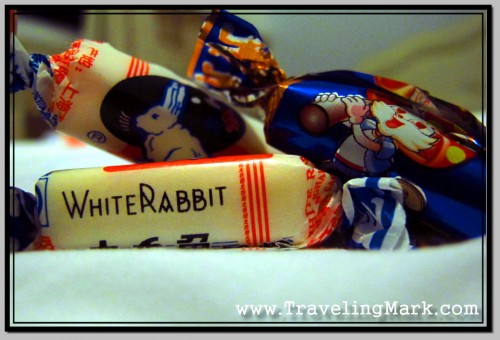
Photo: White Rabbit Candy - Traditional Chinese New Year Sweets
I craved sugar in the wilderness more than anything and was dying to have something sweet in my mouth often. Prunes and almond butter did satisfy this craving, but being domino foods, I found it incredibly difficult to stick with proper rationing. I only had limited supply of both and knew I couldn’t have more than one prune and one spoon of almond butter after each meal if I were to avoid running out prematurely. I could not do it.
Domino foods are very treacherous. You start with one, and must have another. The sensation they leave in your mouth makes you want to continue and that power can trick you into breaking any pact you made with yourself. As a result, I unintentionally depleted my valuable sweet tooth resources long before completion of my three months long withdrawal. It taught me how desperately addicted to sweets I was.
After 3 month in the wilderness, and knowing I wanted to do this again for at least a year, I realized that my biggest challenge of all will be to overcome craving for sweets. I would never in a thousand years fathom sweets as a possible holdback. If you asked me prior to my three months in the wilderness what I thought were gonna be the toughest challenges to overcome, sweets would have never even appeared on that list if I’d made it a hundred points long.
Now that I look back at my hermit experience, I’m surprised to realize that none of what common sense would dictate as the most probable causes of concern, such as solitude, deprivation, harshness of the environment, or similar were able to defeat me. At the end of the day, it was the most unlikely thing I would never give a second thought to that did me in.
Out in the civilized world, you’re never too far away from a vending machine or a place selling Snickers bars, or cookies, or carbonated beverages, or ice cream, or cheese cakes. With all these goodies available on every corner, satisfying sugar cravings takes zero effort so one doesn’t even realize how deeply addicted to sugary things we get.
It takes complete withdrawal with no chance of getting an easy sugar fix to realize the extent of this addiction. I learned it the hard way and found three month not long enough to have the sugar cravings overcome. As of right not, sugar cravings remain the most difficult to admit and find a solution to holdback I’ll be faced with on my upcoming long term wilderness experience.
When stranded in the wilderness, the most prominent concern of an unintentional survivalist is “what will I eat?” The fear of starving to death irrationally takes over from more rational fears. While each survival situation is different, truth be told – starvation is one of the least severe threats to a person in the wild.
Photo: Procurement of Food is One of the Least Pressing Needs for a Survivalist in the Wild
As the rule of threes would have it – you can die in three minutes without oxygen or when bleeding profusely (making the need to treat injuries the #1 priority), you can die in 3 hours from exposure to elements (making the need to have shelter and fire the #2 priority, though this priority changes from situation to situation), you can die in 3 days from dehydration (making the need to find source of drinkable water your #3 priority, though this also changes from one environment to another), but it takes more than 3 weeks to die from starvation (making procurement of food one of the least pressing needs in a survival situation).
The rule of threes is well known to the survivalists, medical professionals and other people in the know, yet even though it makes the procurement of food look like a waste of energy when more urgent needs put one’s life at stake, it’s important to realize that even though starvation takes while to kill you, it will leave you weak both physically and mentally and weakened body and mind won’t keep a person alive for very long. Especially not when they’re on their own devices, with little chance of help from the outside sources.
Still, it’s necessary to realize that unlike water (unless you’re in a desert), procurement of enough food to keep you going in the wilderness is an ongoing struggle which requires a great deal of time and energy and needs to be repeated day after day. Water sources, on the other hand, are much easier to find, they do not try to flee from you and once a plentiful source is found, your hydration problem is solved, and it is solved indefinitely.
As an important note, I would only briefly mention that if you’re stranded in the wilderness involuntarily, signaling should be one of your top priorities and should be on your radar long before you even start thinking about procurement of food or water. Unless, of course, you do not want to be found – kind of like when I went into the wild.
My withdrawal into the wilderness was not meant to be a test of my wilderness survivalism skills, even though any stay in the wilderness IS, ultimately, a test of wilderness survivalism skills. Still, I went into the wild to seek answers to deeper questions, to reattach my connection with Mother Nature and to enjoy company of celestial beings, whose company can only be enjoyed in absence of men.
What I Ate in the Wilderness
Since I had a car at my disposal, I stocked up on food before disappearing from the civilized world. Freshly caught fish was to be my source of animal protein, but I brought with me a supply of dried organic pinto beans to use as main accompaniment with the fish. Aside from being very nutritious, beans are loaded with fiber and slowly absorbing carbohydrates so I’d never lack energy and wouldn’t feel hungry. I used beans the same way you’d use rice. I didn’t have salt or any other spices or seasoning, yet I found the taste of beans boiled in nothing but pure water as delicious as ever.
I also packed in a large bag of organic garlic, which lasted for almost whole three months. Garlic is packed with vitamins and contains compounds known for their antibacterial, antiviral and antifungal properties. To satisfy my spicy tooth, a sack of Thai hot peppers was an absolute must have, unfortunately my spicy tooth made me go through them way too quickly leaving the resource depleted shortly after first month.
Another amazing survival food I took with me was organic almond butter. I packed in 5 large jars yet even though I originally thought I was being ridiculous taking so much of it, I went through all of it in less than two month. I started with two spoonfuls three times a day – after each meal – but after one whole jar went empty on me shortly after one week, I restricted the intake to one spoon after each meal. Still, I spent all almond butter long before whole three months were over. There is a lot of goodness and a pile of energy in every single spoonful of almond butter. I strongly recommend it to help with survival when one doesn’t have to carry their food in a backpack with them.
To further help keep myself healthy, I also packed in a huge bag of dried organic prunes (or dried plums, as word prune implies it’s a dried fruit already). This antioxidants rich preserved fruit makes for an amazing desert after meals. Problem with delicious goodness of prunes (which is the same with almond butter) is that they are so tasty, you can’t have just one. I had enough prunes to last me three months if I only stuck with one after each meal. I could not do that.
As a backup in case of emergency, I also brought with me dozens of granola and protein bars. I ate half of them in the first week and a half of my stay. The initial week was the most difficult time when junk food and sweets withdrawals kept me in a state of vicious torment. Diet composed of freshly caught fish, organic beans and garlic however made dealing with withdrawals easier and soon I found myself feeling so internally clean, a mere thought of junk food made me feel sick.
Positive Change in Diet
Cold turkey change in diet left a very positive impact very quickly. I felt much more energetic and healthier within first two or three days. The overall wellbeing of my physical body, just from this immediate change in diet was profound. I heard my body speak to me of how relieved it was having had the burden of awful diet lifted of its shoulder.
I wished I had access to fresh vegetables, as with them, I could make it even better, but alas, it wasn’t the case of this experience. I will, however attempt growing my own garlic, onion and kale when I withdraw into the wilderness next. I’ve been educating myself actively on gardening and feel ready to take this challenge on. I may even attempt to grow Enoki mushrooms which can be grown in small places indoors.
The biggest challenge with wilderness indoor gardening would be to succeed in growing anything at all in winter, when daylight is limited and temperatures extreme. I’ll give wilderness indoor gardening my best try long before winter comes and will rely on trial and error to teach me the ins and outs of it so hopefully by the time winter comes, I’ll have a chance to succeed.
I think the three months in the wilderness was the time in my life when I had the healthiest diet in my life and it did leave its mark. Falling back into the junk food craze was… sadly – easy. My reintroduction into the civilized world didn’t go without stress and peer pressure which resulted in my clogging the digestive system up with crap food very quickly. The crappier food I ate, the crappier food I desired and before I knew it, everything I gained in terms of overall well being with food I ate in the wilderness, was irrevocably lost. Can’t wait to return to the wild again very soon.
As a traveller, dining in Laos is also not as cheap as in other SE Asian countries. When it comes to food, Laos adopted that crappy discriminating practise widely popularized throughout Cambodia. Just as it is in Cambodia, Laos eateries believe that it is perfectly justifiable to overcharge (rip off) foreigners so getting food for the price a local would pay is rare.
Restaurants in popular tourist areas have menus in both Lao and English, but don’t be fooled by the fact that it’s bilingual. This is just an illusion created to make you believe that you are getting a local deal, but the prices on the menu only apply to foreigners. A local would come, look at the menu, smile at it, put it aside and ask in a language you cannot understand how much it was going to be for him which will never end up being the same as what you as a foreigner would have to pay.
Out of this part of South East Asia, Thailand is the best country when it comes to the availability of locally priced food available to foreigners. Prices in Thailand are often clearly marked and visibly posted, even if you go to the most non touristy market in an area where you will have been the only foreigner in ages. Yet the price posted will apply globally – this is how much this particular item costs and everyone, regardless of their color of skin will pay this amount. There is no such thing as different price for different people. Sadly, that’s not how it works in Laos. As a tourist, aside from finding transportation and accommodation vastly overpriced compared to other countries in SE Asia, I also found lack of inexpensive foods available to foreigners financially exhausting.
Bowl of fried rice with squid and shrimp can be had for $1 in Cambodia. That same amount will buy you steamed rice with nice dose of (really spicy, mind you) chicken stew in Thailand and in Vietnam, you could also almost throw a beer in it with food but forget about getting a decent portion for an equivalent of $1 in Laos.
Pakse in southern Laos was the only place where white bread sandwich with friend egg and veggies could be had for 8,000 Kip (roughly $1) but be prepared to shell out more everywhere else.
Overall, even for a skilled budget traveller capable of finding the means to travel, sleep and eat on the cheap, Laos happens to be an expensive trip. As a foreigner, the cost of food will be out of proportion to what locals pay but that’s a sad reality of many places in the region.
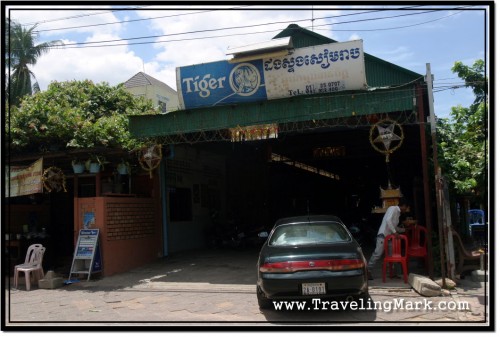
While most locally run Cambodian businesses are not very customer friendly, there were exceptions worth doing business with. One of them was a local Cambodian restaurant on the east bank of the Siem Reap river, a block north of the independence bridge (about three houses back). The restaurant was clearly not targeting tourists as it was not on any popular tourist path and it didn’t even have an English name. None of the staff spoke any English, but where there is will, there is way to communicate.
Photo: This Local Cambodian Restaurant Has No English Name
Even though this restaurant was locally owned and run, it did not support discrimination and the same rates applied along the full spectrum of customers, regardless of their color of skin. Menu had items listed in Khmer language with some English translations to the right of it. Those translations seemed to have been put together by consulting a dictionary, instead of an English speaking person and had to be taken with a grain of salt, but gave reasonably clear idea as to the dish. There were occasional surprises, though:
Several items in the menu were translated into English as “Chicken and Vegetables” however what it ended up being was chicken stomachs with vegetables. Similarly, there would be a column of five dishes each with different Khmer name, but English translation for each of them was the same. The very first meal I ordered had its name listed in English as “Fried Egg with Tuna”. This was pretty close to what I got, except that the fish that came within this uniquely looking and tasting omelette was not tuna. It was some small, fresh water fish. Not a big deal.
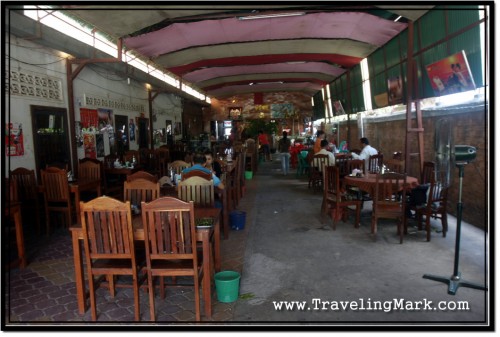
Photo: This is What My Favorite Local Cambodian Restaurant Looked Like Inside
The same menus were used by everyone – locals and foreigners alike and the same prices applied to everyone equally. Everyone regardless of their ethnic background also received the same level of service and courtesy, although I could only compare it with myself as I have never seen another foreigner ever dine in that restaurant. Still, despite being a foreigner, I have never been charged extra just because I looked different.
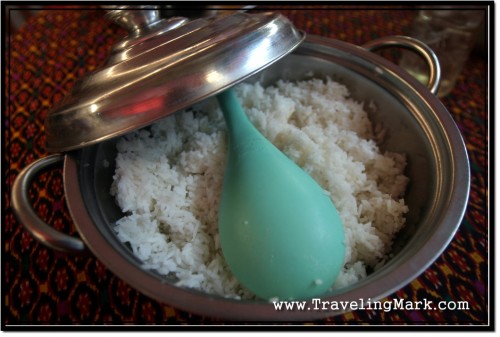
Photo: All Customers Get More Rice Than They Can Eat
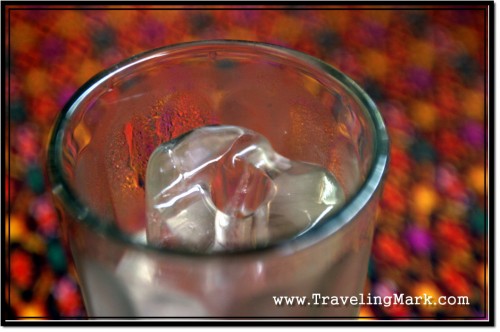
Virtually every meal they had in the menu was listed at mere 7,000 Riels (approximately $1.75) which included unlimited rice and tea (within reason, of course). Best of all, despite being a local restaurant, all customers were provided with safe-for-drinking ice to cool the tea down with. This was great since many locally run eateries use cheaper, industrial ice which is produced in unsanitary conditions using unsafe tap water. For your information – safe ice has smooth, cylindrical shape with hole in the middle of it, whereas unsafe ice is just an irregularly shaped crushed mass.
Photo: Safe Ice Served by the Local Cambodian Restaurant
Food in the restaurant was fantastic. Preparation never took too long and every dish I tried had great taste to it. I also asked the students in my English class to teach me how to request no MSG in my food in Khmer language because no one in the restaurant spoke any English and I wouldn’t be able to continue dining there if they kept adding it to my food. Luckily, the cook had no issue with cooking without MSG for me so I was all set. BTW, it’s easy to remember how to say No MSG in Khmer – it sounds very similar to saying “No BJ” in English. You literally just use the abbreviation of “blowjob” and add “No” before it. If you can memorize “No BJ, no masau soup” they will know exactly what you are asking for and will gladly leave it out of your food.
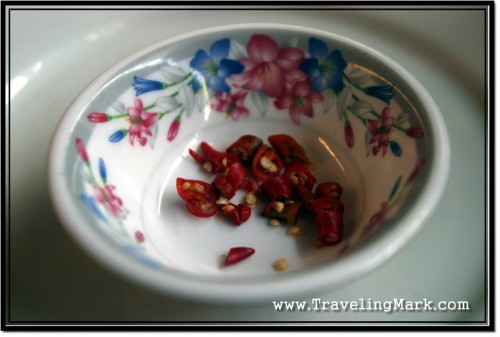
Photo: Customers Also Got Complimentary Chilli Peppers
For a few weeks, this local Cambodian restaurant was my favourite place for eating. It got pretty busy around lunch hour so I tried to avoid going there at noon but outside of breakfast (very early in the morning), lunch and dinner times the place was quiet and enjoyable. Everything was a little too perfect about it. They did not discriminate, food was great and well priced, ice was safe and No MSG requests were complied with. They never tried to overcharge me just because I was a foreigner so I kept supporting the business until the day the owner crossed the line and attempted an overcharge.
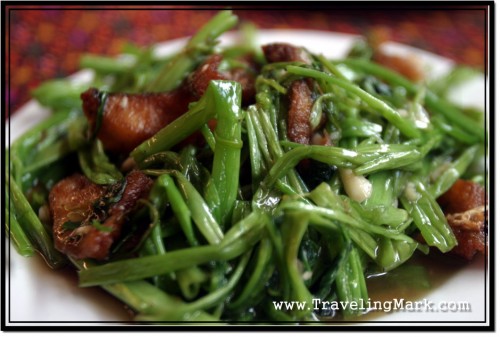
Photo: Fried Morning Glory with Fish - My Favorite Dish
It was after a very long time of regularly dining there and never having a problem, when some woman walked in with a tray full of rice cakes. These were small, pinky sized rolls of rice wrapped in a banana leaf. Presence of raisins and some other fruit gave them slightly sweet taste which worked perfectly as an after-meal desert. Because this took place after I had spent more than a month in Cambodia, I could already understand some of the language, especially the numbers, so I overheard her asking for 100 RielS when she was offering the cakes to other customers (other locals who were also dining in the restaurant).
After having offered her rice cakes to everybody else, the woman eventually came to me. I had just finished my meal and the owner of the restaurant was by my table as I was paying for my food. Realizing that the woman didn’t speak any English, I made a hand sign with the money I was still holding in my hand for her to show me how much per cake. At that point the owner of the restaurant who was still by my table and felt compelled to “help” me understand the price took the receipt and wrote “200” on it.
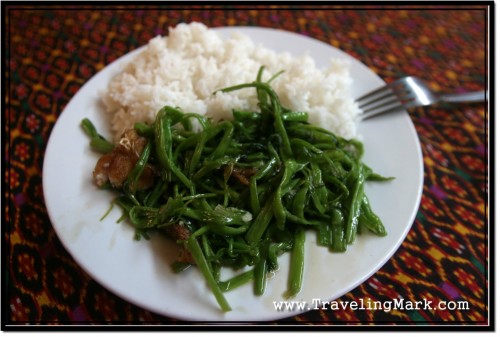
Photo: Complete Meal for 7,000 Riels. Too Bad the Owner Got Greedy
I ended up buying that one cake for 200 Riel but felt like this was a major breach of trust. Needless to say, it was the last time I dined in the restaurant. He was always fair with me before so it was really disappointing to reach the point at which he would try to rip me off because I was a foreigner. Was the desire to earn easy 100 Riels by overcharging a foreigner really worth losing a loyal customer?
Even though excessive amounts of MSG (Monosodium Glutamate) added to the food I was eating with the villagers from Sras Srang during the last day of the Pchum Ben Festival made it taste awful so I didn’t have much of it, I still had enough to cause further stomach problems. At this point I had enough pointers to start being apprehensive about MSG and went on the internet to read up on it.
As with many other things, the information available on the internet is rather conflicting. Some said intake of MSG was harmful, while others stated they experienced no problems whatsoever, even after years of use. It was hard to come to a solid conclusion based on other people’s reports, but potentially harmful side effects caught my attention so I started to ask around in restaurants whether they could cook the food for me without MSG.
Eating MSG Free Foods
Harmful or not, I didn’t feel like eating too much food that had its taste enhanced with chemical seasoning. In my mind, the premise was simple – I’d ask a waiter in a restaurant if it was possible to cook the dish I’d order without any MSG. I said I didn’t care if the cook thought it didn’t taste right without MSG, but I made it a requirement if they wanted to get my business. I made it clear that it didn’t matter to me what they believed each dish needed in order to taste right, or what they’d continue serving to other customers, but as for me… you either ensure there is no MSG in my food, or I will never dine in your establishment again.
Unfortunately, Khmer Family Restaurant was unable to accommodate my requests. I used to dine there a lot but since I couldn’t get anyone to take my requests seriously, I quit going there. Luckily, there is no shortage of restaurants anywhere a guy goes and many will be more than happy to oblige in order to earn your business so this was not an issue. Amazingly enough, after I started asking for no MSG in my food, the stomach problems went away.
Habit of Asking for No MSG
Since I already know what the food with loads of MSG smells and tastes like, I could often tell whether what I was served had the taste “enhanced” with it, or not. However this is not always possible as small amounts of it won’t have much impact on taste. It’s like with salt – if you overdo it, you can tell the dish is too salty, but if you put just right amount, then it simply tastes just right.
There were a few occasions when I forgot to ask for no MSG and I found out about it the following day when the stomach cramps came back. Since I was supporting the establishments that were happy to accommodate my requests for no MSG in my food, after a few regular visits I no longer needed to remind them of how to cook for me. But that threw me off the habit of asking for no MSG each time I was ordering food and failed to do it with a few restaurants in which I hadn’t dined before.
Why Such Sensitivity to MSG?
I attribute my initial sensitivity to MSG to clean digestive system. My diet consisted of at least 80% organic food when I was in Canada. Everything that could be had in 100% organic form was a staple of my diet with the rest consisting of either organic, or if not available, then natural foods. Not everything could be had organic, but majority of my diet was chemistry free (except from occasional fast food munchies) so my digestion was nice and clean.
But then when I came to Cambodia and started bombarding my stomach with excessive MSG, the impact was instantly noticeable. I appreciate that people who eat foods full of pesticide all the time have their digestion used to the chemicals and may not feel the negative effects of MSG so harshly. That’s perhaps how one could explain the conflicting reports on MSG intake on the internet.
MSG Free Dining
From my own experience, MSG is definitely bad for your health and has a very negative effect on your body. Elimination of MSG from my diet resulted in elimination of stomach problems I was experiencing while eating foods that contained MSG. But seeing how more and more restaurants with signs that none of their foods contain MSG keep popping out all over Asia, I’m guessing I’m not the only one who experienced similar problems with MSG and that resulted in growing demand for MSG free dining.
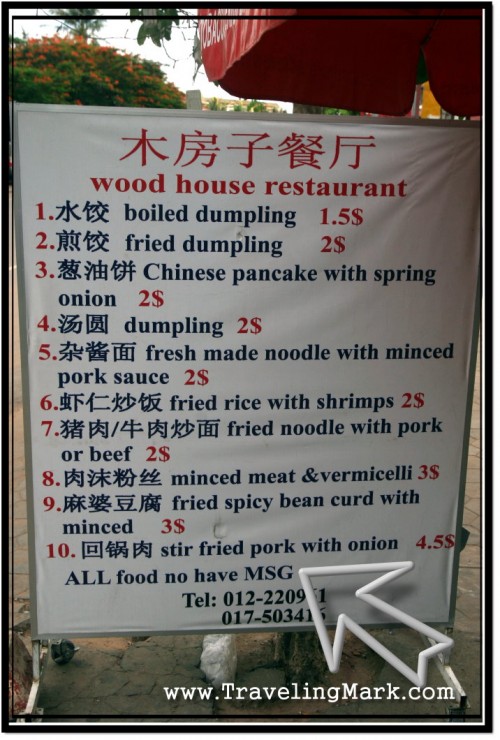
Photo: Growing Demand for MSG Free Cooking Signals There Is Something Fishy About the Additive
My initial days in South-East Asia were accompanied with excitement. Not only am I a big fan of Asian kitchen, it was also encouraging to see that I could buy a complete meal for some $3 in Cambodia. I have a stomach of steel that doesn’t get easily upset, but when I realized that I will be eating homemade, cooked food for the next little while, I started looking forward to significantly improved health. Swapping canned dishes and junk food from fast food restaurants with cooked, restaurant-style meals is bound to positively affect my overall health, right? Well, that’s what I thought.
That’s why it shocked me when shortly after arriving to Cambodia I started experiencing severe stomach pains. My stomach, which handled most dubious foods in the past without a wink started giving me insane problems shortly after my initiation to Cambodian food. It was making no sense. I expected to start feeling better, not significantly worse. The cramps were not something I could easily ignore either. When a cramp got me, it delivered intense stomach pains as if I had an Alien trying to rip out of my innards. It would take a hold and not let go for good two minutes.
Search for Causes of Stomach Problems
I was really having hard time trying figure out what could be causing it. After more than a week of persistent stomach pains, I knew I needed to start looking for the reason that causes them. There was no way a simple change in diet could have had such severe effect on my digestive system. I knew there must have been either particular food or a particular drink that was causing it. I only drank bottled water and even brushed my teeth with it, so I didn’t anticipate the cause of problems originating from there, but I was determined to nail it down at any cost. I deployed the elimination method.
Each day I completely left out something out of my diet what I used to eat during my stay in Cambodia so far. If stomach problems continued even after elimination of that particular food or drink, I would go on to eliminate something else until it becomes clear where the cause of problems lied. I even suspected beer as I used to have a couple glasses every day but to my joy it wasn’t the case. I enjoy a good glass of cold beer so having to go without would be rather painful, but I guess I would just need to try a different brew which was not a big deal. I really couldn’t imagine beer possibly causing any stomach problems, but I needed to be sure so I tried. Luckily, it wasn’t the beer that cause my stomach problems.
Food Additives and Stomach Problems
As I kept moving forward with my experiment, it became clear that this was strictly food related and nothing I was drinking was causing the problems. However, it also became clear that it’s not just general food, it’s something added to the food that causes it. I could for example eat Cambodian Lok Lak dish and not get cramps from it, but if I ate Cambodian Amok Fish, the cramps would be there. However, grilled fish with rice caused no problem at all. It was not fish, it was not rice, it was not vegetables or fruit and it was not other meat. So what was it?
I kept getting closer and closer to the answer but didn’t quite have it nailed down until the last day of Pchum Ben. I was invited to take part in the celebrations by the villagers from Sras Srang village in the Angkor area and it involved big lunch on the side of the moat surrounding Angkor Wat. Munchies were done the Cambodian way – everybody joined the food they brought with the food of others creating a feast of available dishes and everyone was free to load up their plate with whatever they liked. Since I didn’t have the kitchen in my room, instead of cooking, I brought a bunch of fruit.
Truly Cambodian Food
I followed the example set by the villagers who gathered round for the lunch and put a little bit of every dish available on my plate. I expected the same or similar tastes I was exposed to in local restaurants so far but these village dishes were nothing like that. Each of them had a very overpowering taste of some bad seasoning that was defeating the taste of everything else. Fish didn’t taste like fish, it tasted like that seasoning. Soup with herbs didn’t taste like soup with herbs, it tasted like that seasoning. The smell and taste of it was so distinct and so unpleasant, I was having hard time swallowing anything but rice.
Even though rice was the only dish that was seasoning free, at least there was one such. It tasted bland because it was cooked without any salt, but at least I had something to put in my mouth. To my disbelief, villagers also brought extra bags of that seasoning that each of the dishes instead of plain rice already had too much of and kept adding spoonfuls upon spoonfuls of it to the mix on their plates. It was a white, powdery substance similar in look to sugar but smelled horribly and made food that contained it taste like crap.
I asked what the substance was and was told that it’s a seasoning they always add to food because it makes it taste much better. I picked up one of the bags and through a bunch of Cambodian script writing I was able to distinguish a few words in English – MonoSodium Glutamate.
This discovery of MSG was a key point that eventually lead to the elimination of my stomach problems. It was just shocking to see how Cambodian villagers think MSG was the best thing since sliced bread and can’t imagine their lives without it. Local shops that specialize in business with the locals sell more MSG than anything else and have shelves full of it, usually placed at the most prominent location of their store. So much love for such a bad thing.
Manage Cookie Consent
To provide the best experiences, we use technologies like cookies to store and/or access device information. Consenting to these technologies will allow us to process data such as browsing behavior or unique IDs on this site. Not consenting or withdrawing consent, may adversely affect certain features and functions.
Functional
Always active
The technical storage or access is strictly necessary for the legitimate purpose of enabling the use of a specific service explicitly requested by the subscriber or user, or for the sole purpose of carrying out the transmission of a communication over an electronic communications network.
Preferences
The technical storage or access is necessary for the legitimate purpose of storing preferences that are not requested by the subscriber or user.
Statistics
The technical storage or access that is used exclusively for statistical purposes.The technical storage or access that is used exclusively for anonymous statistical purposes. Without a subpoena, voluntary compliance on the part of your Internet Service Provider, or additional records from a third party, information stored or retrieved for this purpose alone cannot usually be used to identify you.
Marketing
The technical storage or access is required to create user profiles to send advertising, or to track the user on a website or across several websites for similar marketing purposes.